
Last updated November 18, 2026
 Architectural shingles
 Metal roofing
 Tile roofing
 GAF
 Owens Corning
 Flat & low-slope
Free roof inspection with deck photos before we talk money - GAF and Owens Corning certified installation
The Complete Gutters & Accessories Guide for Enterprise Homeowners
Enterprise gets about 4 inches of rain a year, which sounds forgiving until you remember how it arrives. A July monsoon can drop 1.5 inches in 45 minutes, most of it in the first fifteen, and the water comes off a roof faster than any gutter sized for a Seattle drizzle can carry. That gap between how much rain falls and how fast it falls is the whole story of gutters in the Las Vegas Valley. What follows is what we’ve learned working on roofs and gutter systems across Enterprise: why standard 5-inch K-style often comes up short, which materials survive desert UV and thermal cycling, which accessories actually matter here, and how to spot the system that’s quietly failing your foundation. If you read one section, read the one on downspout sizing.
Quick Answer
Most Enterprise homes need 6-inch seamless K-style gutters with 3×4-inch downspouts, not the 5-inch gutters with 2×3-inch downspouts that national installers commonly fit. The reason is storm intensity, not annual volume: a Las Vegas Valley monsoon delivers rain at a rate that overwhelms undersized systems, sending overflow straight down against the foundation on flat lots that have nowhere to drain. Larger gutters, larger downspouts, and drainage that carries water well away from the slab are the right specification for this climate.
Styles & brands we work with
- Architectural shingles
- Metal roofing
- Tile roofing
- GAF
- Owens Corning
- Flat & low-slope
Table of Contents
- Why Standard 5-Inch Gutters Are Undersized for Enterprise
- How to Tell If Your Gutters Are Undersized
- Gutter Materials: Honest Performance in Desert Conditions
- The Accessories That Actually Matter Here
- What “Seamless” Really Means Structurally
- HOA and Clark County Considerations
- What Gutter Work Costs in Enterprise
- A Maintenance Routine That Fits This Climate
Why Standard 5-Inch Gutters Are Undersized for Enterprise
A gutter’s job is measured in gallons per minute, not inches per year. That distinction matters in Enterprise more than in almost any market in the country, because the average annual rainfall tells you almost nothing about peak flow. The number that matters is the storm intensity: how hard it rains for the worst 20 minutes of the worst storm of the year. In the Las Vegas Valley, that number is high.
Here’s the practical math. A 5-inch K-style gutter carries roughly 5,500 square feet of roof area at a moderate rain intensity, but that capacity drops sharply as intensity climbs. Push it to monsoon rates and the same gutter handles less than half that. A 2×3-inch downspout, meanwhile, can drain only about 600 square feet of roof under heavy load. On a typical Enterprise home with 2,500 square feet of roof and three downspouts, that’s a system designed for a storm that doesn’t happen here.
What happens when the math fails? Water backs up over the gutter lip and sheets down the fascia, the stucco, and the ground right beside the slab. On a flat desert lot with caliche soil that sheds water slowly, that overflow pools against the foundation. Over a few seasons, that’s how you get stucco staining, fascia rot, and the kind of soil movement that shows up as hairline cracks inside the house.
The fix is a wider system with bigger outlets. Six-inch K-style gutters roughly double the capacity of 5-inch, and 3×4-inch downspouts move about twice the water of 2×3. For homes with large roof planes, tile roofs, or valleys that concentrate flow, we sometimes recommend 7-inch gutters and additional downspout drops. Bigger is not marketing here. It’s a flow calculation.
How to Tell If Your Gutters Are Undersized
You don’t need a ladder to make a first pass at this. Most of the tell-tale signs show up at ground level after a storm, and a few are visible any day of the year.
- Look for overflow stains on the fascia. Dark streaks or mud lines on the wood or composite board directly behind the gutter mean water has been going over the top, not through the system.
- Check the ground along the foundation after a storm. Splash marks, eroded gravel, or a visible channel in the dirt below a downspout outlet all point to water dumping where you don’t want it.
- Measure the gutter profile. Hold a tape measure across the open top of the gutter. Five inches is the standard residential size; six is what we specify for most Enterprise roofs.
- Measure the downspout outlet. Rectangular downspouts are commonly 2×3 or 3×4 inches. If yours are the smaller size, capacity is limited regardless of gutter width.
- Count the downspouts. A workable rule is one downspout for every 30 to 40 feet of gutter run, more on roofs with steep pitch or large valleys. Fewer than that and the system bottlenecks.
- Watch during a storm, from a safe spot. Water sheeting over the front lip in anything less than a heavy downpour means the system is already at its limit.
Any one of these signs is worth a closer look. Two or more together, and the system is telling you something. For the roof above those gutters, our team offers Roof Repair in Enterprise with photo documentation of everything we find.
Gutter Materials: Honest Performance in Desert Conditions
Material choice in Enterprise is less about rain and more about sun, heat cycling, and what falls into the gutter. Palm fronds, mesquite leaves, and desert landscaping debris behave differently from the maple leaves and pine needles you read about in national gutter guides.
- Aluminum (most common). Lightweight, rust-resistant, and available in seamless form on site. Standard 0.027-gauge aluminum holds up reasonably well, but the .032-gauge is worth the upgrade in Enterprise because the extra thickness resists denting from palm fronds and thermal flexing. Paint fades in full sun over 10 to 15 years, faster on west-facing runs.
- Steel. Stronger and more dimensionally stable than aluminum, which helps in a climate that swings from 30 degrees on a January morning to 115 in July. Galvanized steel can rust at cut edges and scratch points, so factory-painted steel is the better choice here. Heavier and costlier, but it holds its shape.
- Copper. The premium option: does not rust, does not fade, develops a patina, and easily outlasts the roof. Expansion and contraction are real with copper, so hangers need to allow movement. Cost is two to three times aluminum, but for homeowners planning to stay in the house, the lifespan math is straightforward.
- Vinyl. The budget choice, and honestly the weakest one for Enterprise. Desert UV makes vinyl brittle over time, and the material expands and contracts significantly with temperature swings, which is exactly how seams open up. We don’t recommend it here.
For gutter systems that need to match a tile or specialty roof, the products from CertainTeed and Boral lines are worth discussing with your installer. Matching the gutter profile and color to the existing roof and fascia is more than cosmetic in an HOA neighborhood. Our Specialty Roofing in Enterprise page covers how these materials work together.
The Accessories That Actually Matter Here
Walk any big-box store and you’ll find a wall of gutter gadgets. Most of them solve problems Enterprise doesn’t have. Here are the four accessories that earn their place on a desert roof.
Oversized downspout guards. Palm fronds, seed pods, and the small gravel that desert landscaping throws onto roofs all end up in downspout elbows. A standard screen guard clogs within a season. Oversized downspout screens with a wide flat profile shed debris better and let water through when it matters. Inspect and clear them twice a year, once in early summer and again after the first monsoon.
Concrete splash blocks sized for volume. A cheap plastic splash block is rated for a gentle trickle, not for the volume a 3×4-inch downspout can deliver at peak flow. Heavy concrete splash blocks stay put under the surge and direct water several feet from the wall. Place them so the water runs onto a protected surface or a graded swale, never onto bare soil against the stucco.
Underground drainage extensions. The best splash block in the world can’t move water far enough on a lot where the yard is nearly level with the slab. Corrugated or rigid PVC extensions carry downspout water 6 to 10 feet or more away from the foundation and discharge it at a point where it drains to the street or a landscaped area. On flat Enterprise lots this is often the single most valuable gutter accessory you can add.
Hidden hangers with screw fasteners. Not glamorous, but the difference between a gutter that holds its pitch and one that sags under the weight of a saturated run. Hidden hangers screwed into the fascia at every rafter work better than the spike-and-ferrule method in a climate that expands and contracts the wood.
What “Seamless” Really Means Structurally
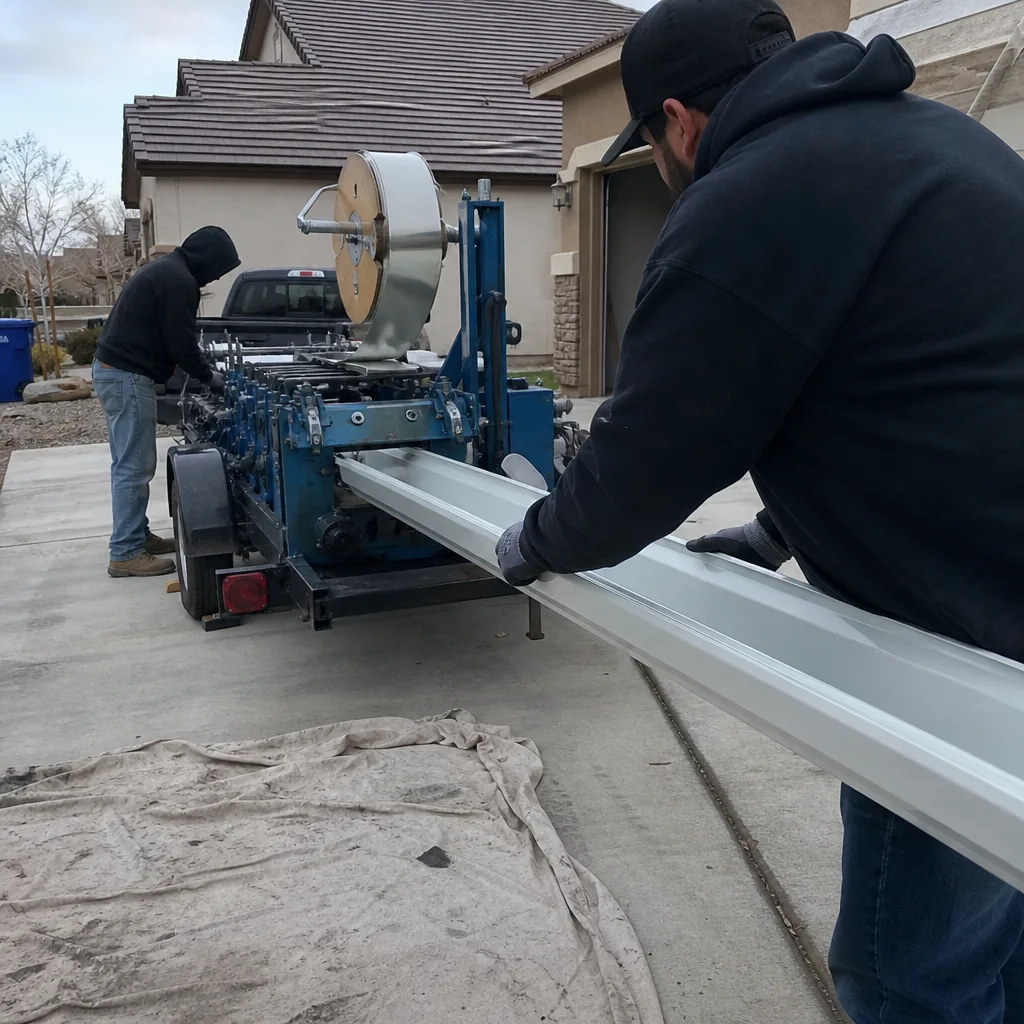
Seamless gutters are formed on site from a continuous coil, so the only joints are at corners and outlets. The national marketing treats this as an aesthetic point. In Enterprise, it’s a structural one.
Every seam is a place where two pieces of metal meet with a small amount of sealant between them. Sealant has a finite lifespan, and that lifespan shortens dramatically when a joint cycles between 30 degrees and 140 degrees on a dark roof surface, dozens of times a year. Thermal cycling is the natural enemy of any seal, and this valley delivers it in abundance.
Seamless runs eliminate the mid-span joints entirely, which leaves only the corner and outlet joints exposed to that cycling. Those joints still need to be done right: riveted and sealed, or better yet, formed with a hidden hanger and a factory-style corner bracket. But there are far fewer of them to fail.
What seamless construction doesn’t fix is sizing. A seamless 5-inch gutter still can’t carry a monsoon. Seamless construction and 6-inch sizing are two separate decisions, and the right system gets both.
HOA and Clark County Considerations
Most neighborhoods in Enterprise are governed by an HOA, and many have architectural review requirements for exterior changes. Gutter work falls into a gray zone that catches homeowners out. A like-for-like replacement usually goes through without a review. A change in material, color, profile, or downspout routing often triggers one.
- Check your CC&Rs before you sign a contract. Look for language on exterior alterations, roof drainage, and approved color palettes. Some HOAs specify colors; some require downspouts to be routed to the street; some restrict visible downspouts on the front elevation.
- Submit the architectural review request early. Most HOAs take two to six weeks to return a decision. If the installation schedule depends on the HOA approval, plan the timeline accordingly.
- Clark County permits vary by scope. Gutter replacement alone often doesn’t require a county permit, but if the work involves fascia repair, structural modifications, or rerouting drainage in a way that alters site grading, permits or drainage review may apply. We check the requirement for every job before we start, and pull what’s needed.
- Decorative fascia matters. Homes with cultured stone, metal fascia wraps, or decorative brackets may not have solid framing at standard bracket spacing. Bracket placement has to be planned around the exterior finish, or the gutters will pull loose within a season or two.
None of this is a reason to skip the work. It’s a reason to hire a contractor who knows how to plan around it. For planned replacements and installations of the roof that feeds those gutters, see Roof Replacement & Installation in Enterprise.
What Gutter Work Costs in Enterprise
Costs below are typical ranges for Enterprise and they reflect actual local market pricing, not national averages. Every property has its own variables, which is why we quote in writing line by line and hold the number on the estimate.
| Work | Typical range | Notes |
|---|---|---|
| 5-inch seamless aluminum, installed | $8 – $12 per linear foot | Standard residential size |
| 6-inch seamless aluminum, installed | $11 – $16 per linear foot | Recommended for most Enterprise roofs |
| 6-inch seamless steel, installed | $18 – $28 per linear foot | Better for severe temperature cycling |
| Copper, installed | $35 – $55 per linear foot | Longest lifespan, premium finish |
| Downspout upgrade to 3×4 inch | $12 – $20 per linear foot | Roughly doubles outlet capacity |
| Downspout guard (oversized) | $25 – $45 each | Clear twice a year |
| Concrete splash block | $20 – $40 each | Heavyweight, sized for volume |
| Underground drainage extension | $150 – $400 per run | Length and trenching affect price |
| Fascia repair (if needed) | $20 – $45 per linear foot | Assessed on site |
What drives the total on your house comes down to linear footage, number of corners and downspouts, gutter height (two-story work costs more), whether the fascia is in good condition behind the old gutter, and how many accessories you’re adding. We give a no-hassle upfront number that reflects the actual job, not a promotional baseline that grows once the crew is on site. Requests for free second opinions on a written estimate from another contractor are welcome, and we offer a standing $50 off any repair over $250.
A Maintenance Routine That Fits This Climate
Gutter care in Enterprise is different from gutter care in Ohio. The main threat isn’t ice dams or heavy snow load; it’s debris from palms and desert trees, plus the occasional UV-induced seal failure. Two focused visits a year will cover most of it.
- Early June, before monsoon season. Clear leaves, palm seeds, and grit from the gutters and downspout outlets. Check that hangers are still tight and the pitch still runs toward the downspouts. Flush with a hose and watch for ponding anywhere along the run.
- Late September, after the storm season. Clear again. Check corner and outlet seals for lifting or cracking. Look for any paint fading, staining, or screw heads backing out. Re-seat splash blocks and confirm underground extensions are still connected.
- After any significant storm. Walk the perimeter, look for overflow stains, and listen for drips with the hose running. A small leak caught now costs far less than fascia repair down the line.
- Every few years, have the roof inspected along with the gutters. Water damage often begins at the roof plane before it shows up in the gutter, and the fascia behind the gutter is a place where rot hides quietly. Our $89 seasonal tune-up includes a photo-documented inspection of the roof and drainage.
Common Mistakes to Avoid
- Replacing gutters with the same undersized system. If the old 5-inch gutters overflowed, replacing them with new 5-inch gutters will overflow too. The right fix is bigger, not newer.
- Skipping underground drainage on a flat lot. A splash block alone doesn’t move much water off a nearly level Enterprise yard. If your downspout discharges onto bare soil against the stucco, you’re feeding the exact spot you don’t want to feed.
- Hiring a storm-chasing crew that uses a local-sounding name. We’ve watched homeowners pay a deposit to a crew that drove into town after a monsoon and was gone three weeks later. Check for a written workmanship guarantee, a local reputation you can verify, and a phone that a real person answers.
- Ignoring the HOA review. An unapproved gutter color or downspout route can force you to redo the work at your own cost. Submit the request first.
- Using plastic splash blocks on a 3×4 downspout. The volume moves them. Use heavy concrete, sized for the flow.
- Forgetting the palm trees. Palm fronds and seed pods are the single most common cause of clogged downspouts in this valley. If you have palms anywhere near the roof, plan for quarterly clearing.
- Attaching new gutters to soft fascia. If the fascia behind the old gutter has begun to rot, new hangers will pull loose. Fix the substrate before the metal.
See the difference
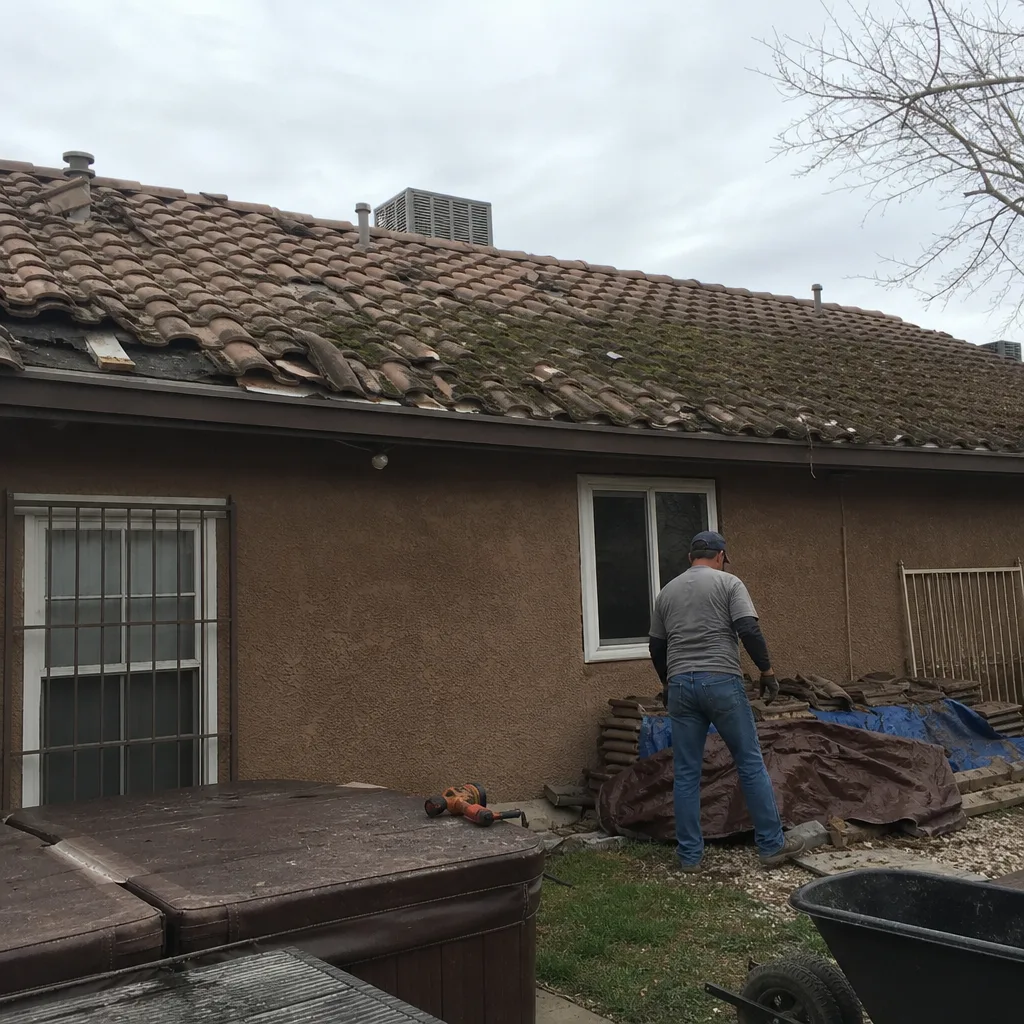 Before
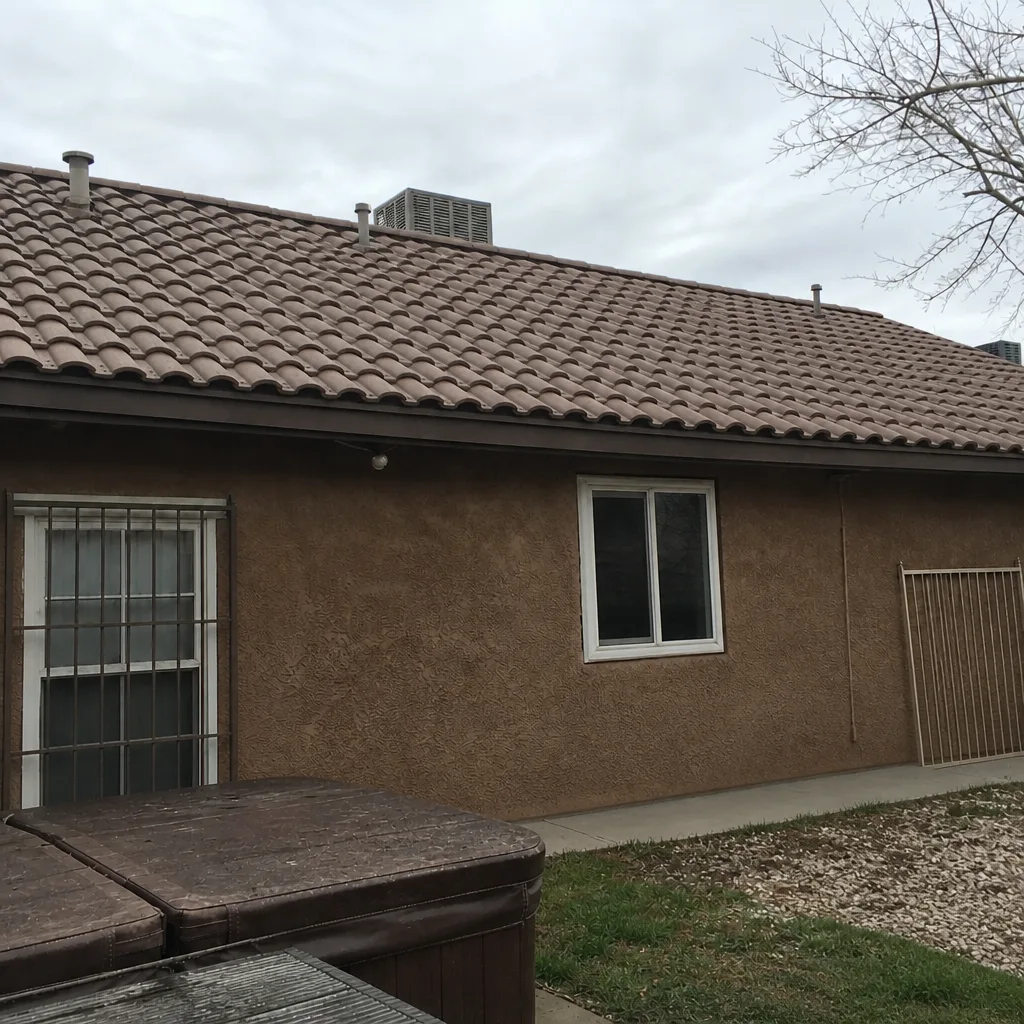 After
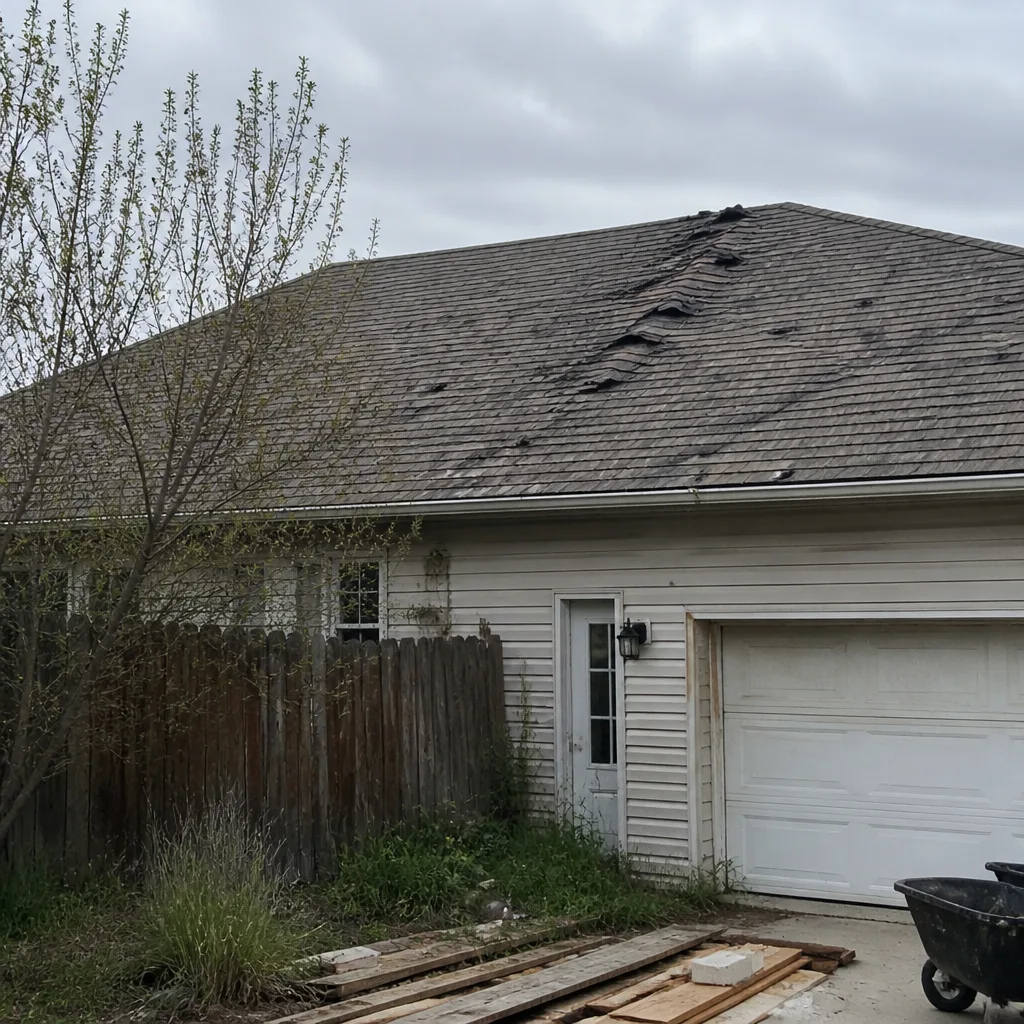 Before
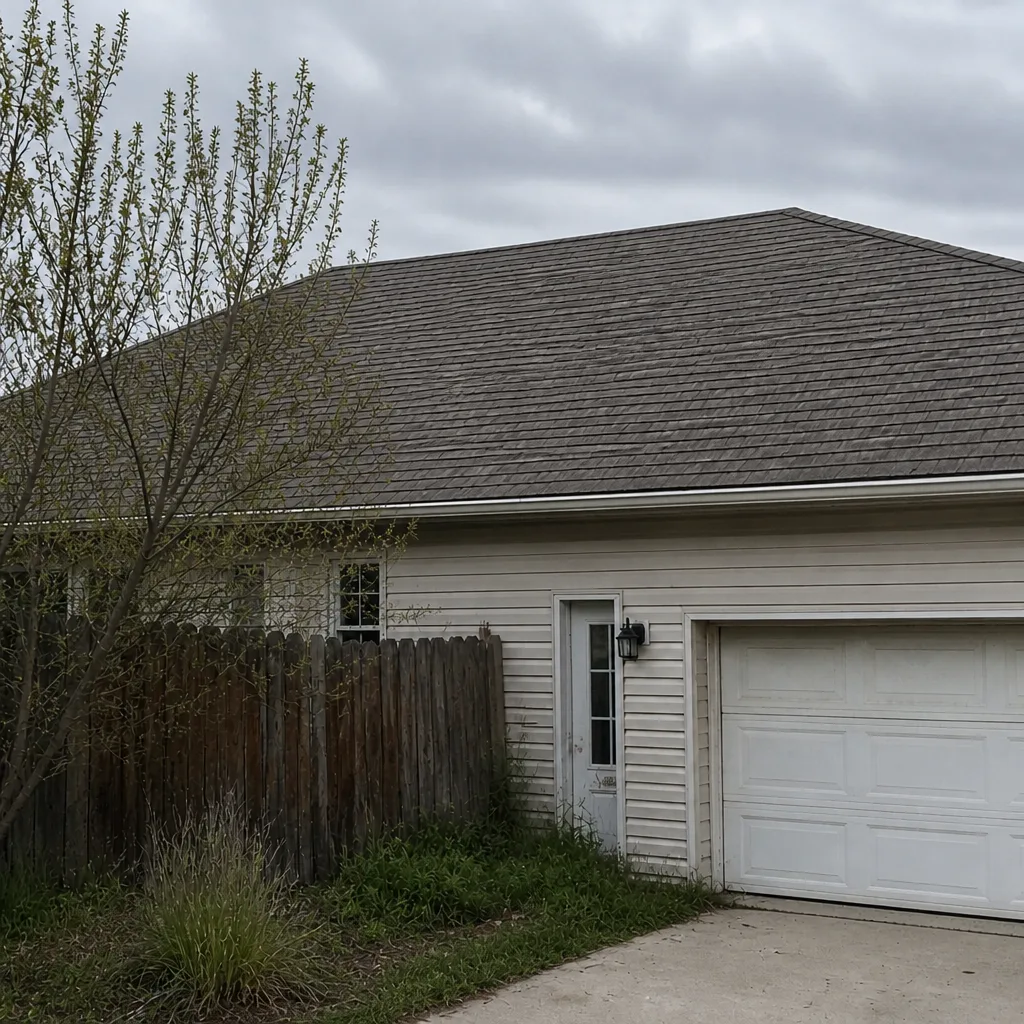 After
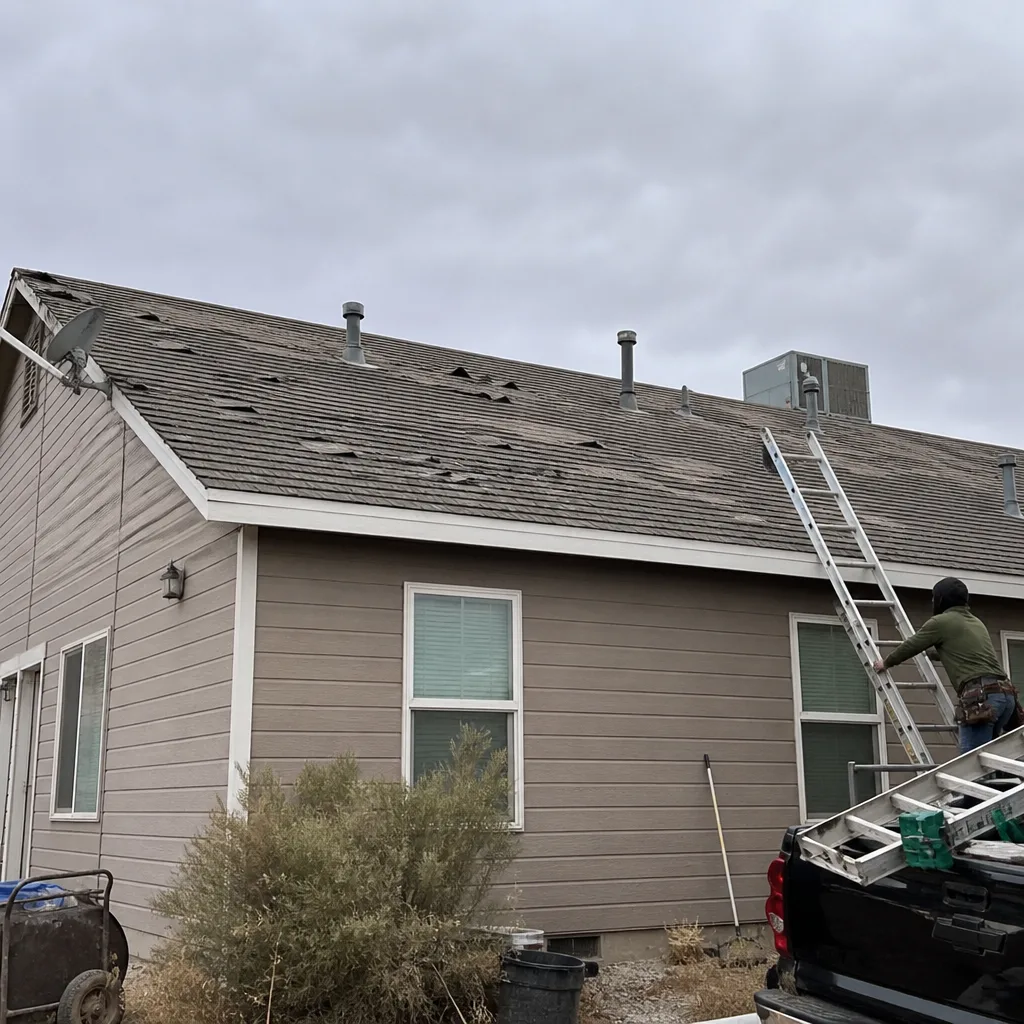 Before
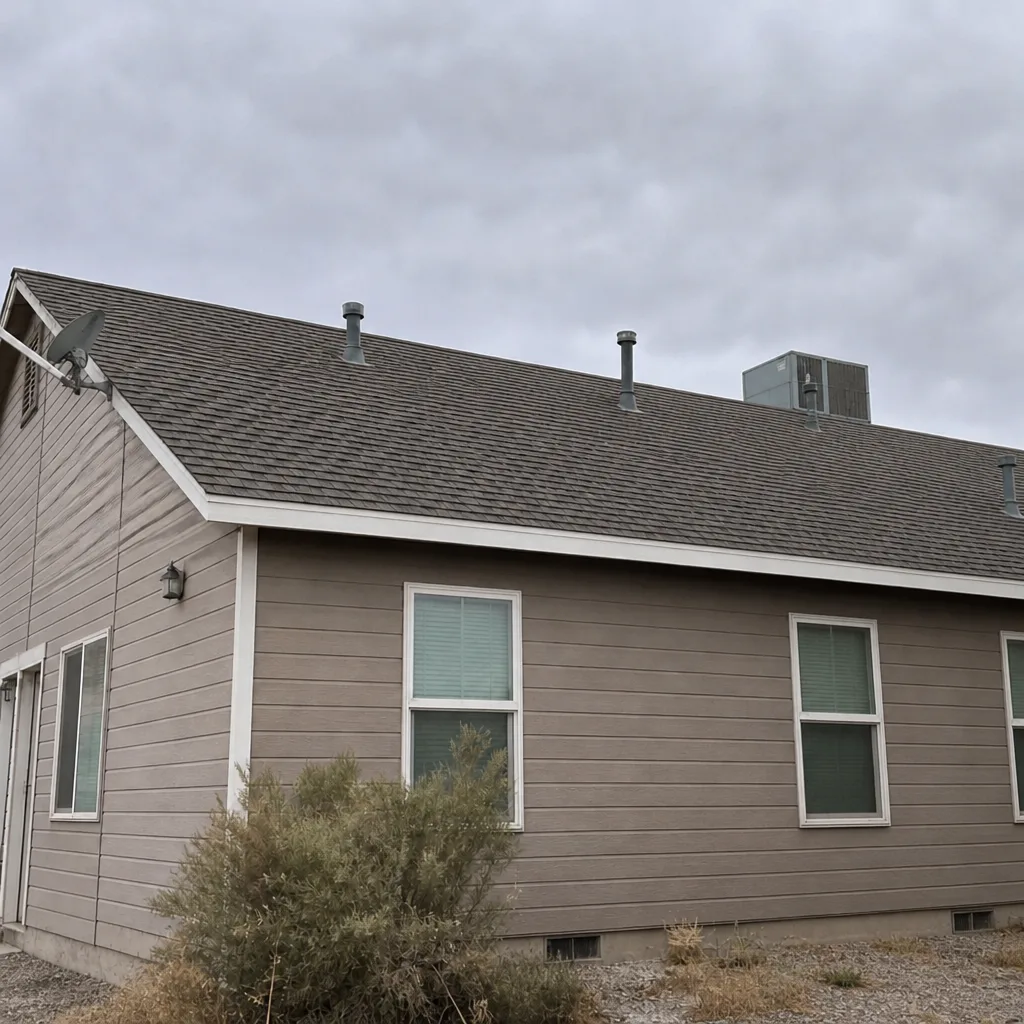 After
When to Call a Professional
Most homeowner-level gutter maintenance is safe from the ground: clearing splash blocks, checking for overflow stains, running a hose from a step stool. What isn’t safe is ladder work near the roof edge, and working on a two-story wall without fall protection is a real injury risk. If your gutter inspection means climbing, or if you’re seeing overflow during normal rain, fascia rot, or water pooling against the foundation, it’s time to bring someone out. Extremely dangerous components on roofs and gutters include high fascia runs, damaged downspout brackets that have pulled loose, and any work at height on tile or pitched roofing. Those belong with a trained crew. Ridgeline Roofing Co. Enterprise offers free estimates in Enterprise. Call (844) 228-4119.
Frequently Asked Questions
Most homes here benefit from 6-inch gutters with 3×4-inch downspouts because Las Vegas Valley monsoons deliver rain faster than 5-inch systems can drain. Five-inch is fine for small roof areas and modest pitch, but a home with more than about 1,500 square feet of roof plane will overflow a 5-inch system during a serious July storm. The upgrade costs about a third more than 5-inch and solves the problem permanently.
Replacing 150 linear feet of 6-inch seamless aluminum with downspouts typically runs $2,400 to $3,400 all in. Add $150 to $400 per downspout for underground drainage extensions, and factor fascia repair if the old substrate is unsound. Call (844) 228-4119 for an exact quote. Estimates are free, and we put everything in writing before work starts.
No. The number on the estimate is the number on the invoice. If we find hidden damage behind a gutter, we stop and discuss it with you before doing anything, and we don’t proceed without your approval. There are no change orders for things we could have seen up front.
Gutter replacement on its own usually doesn’t need a Clark County permit, but the work often involves fascia repair, structural modification, or drainage changes that do. We check the requirement for every job and pull what’s needed. HOA architectural review is a separate step, and we coordinate with the timeline.
A typical single-story home with 150 to 200 linear feet of gutter is usually a one-day job. Two-story homes, tile roofs, or jobs with underground drainage can run into a second day. We tell you the expected timeline in the estimate and call you if anything changes on the day.
Every job is backed by our written 90-Day Done Right Promise. If something we installed isn’t right within that period, we come back and make it right. No paperwork runaround, no arguing. Manufacturer warranties on the gutter material apply on top of that.
The Bottom Line
Gutters in Enterprise are a storm-volume problem, not a rain-total problem. Six-inch seamless gutters with 3×4-inch downspouts, sized to the actual roof, are the correct specification for this valley. Choose a material that survives the UV and heat cycling (aluminum is solid, steel and copper last longer), invest in oversized downspout guards, concrete splash blocks, and underground drainage on your flat lot, and plan for two cleanings a year around monsoon season. Skip the plastic splash blocks and the storm-chasing crews. For the roof above, our Ridgeline Roofing Co. Enterprise home page is the best place to start.
Call (844) 228-4119 for a free estimate. We answer the phone at any hour, and the number on the estimate is the number on the invoice.
Written by the team at Ridgeline Roofing Co. Enterprise.